Teaching

Geometric Modeling for Mechanical Design (MEEN 210)
MEEN 210 is a fun course that focuses on teaching the fundamental principles and practice of geometric modeling, computer-aided design (CAD) through Solidworks, part modeling (solid and reference features), assembly modeling (kinematic mates), top-down and bottom-up design, basics of design process, projections and drawings, geometric dimensioning and tolerancing, reverse engineering, 3D printing, and laser cutting. The course's holistic approach combines theoretical foundations with practical applications while maintaining strong connections to real-world design challenges. This has proven particularly effective in developing both technical competency and design thinking skills.
Key pedagogical innovations include yearly themed projects (such as "Design Begins at Home" in 2017 and "Design for the Elderly" in 2018), which have led to increasingly complex multi-disciplinary solutions incorporating micro-controller programming and electronics. The course has been enhanced with expanded modules in 3D printing, where students now directly operate printers and optimize parameters, as well as additional manufacturing methods including machining and laser cutting. A significantly revamped reverse engineering component features live product disassembly demonstrations, 3D scanning theory and practice, and projects for wearable device design.
Advanced Product Design (MEEN 601)
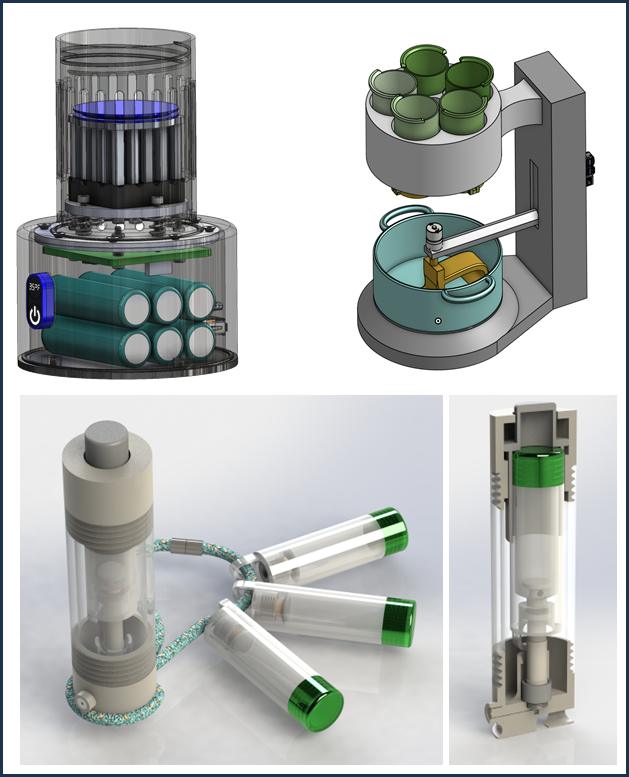
MEEN 601 is a graduate level core course that involves an innovation-oriented design experience that bridges theoretical foundations with practical applications. Students are introduced to design thinking methodologies from IDEO, emphasizing the desirability-feasibility-viability framework that resulted in several innovative student projects. To address common barriers in concept generation, a comprehensive module on design visualization is taught with a lectures on hand sketching in 2-point perspective and collaborative sketching exercises (C-Sketch) where students worked in groups of four to overcome sketching inhibitions.
This traditionally lecture-heavy course has also been enhanced with interactive class activities, such as a live House-of-Quality exercise where students collectively design a new burrito production and delivery system. The course is often sprinkled with student assignments to promote a deep-dive into the business aspects of product design. Two examples include case study analyses of wearable devices like Google Glass and smartwatches as mini projects and Pareto analysis of smartphone feature datasets. These mini-projects encourage students to critically evaluate real-world design decisions. These innovations maintained the course's theoretical rigor while creating an engaged learning environment that connected advanced CAD concepts with contemporary design challenges.
Generative Design - Principles, Algorithms, and Applications (MEEN 703)
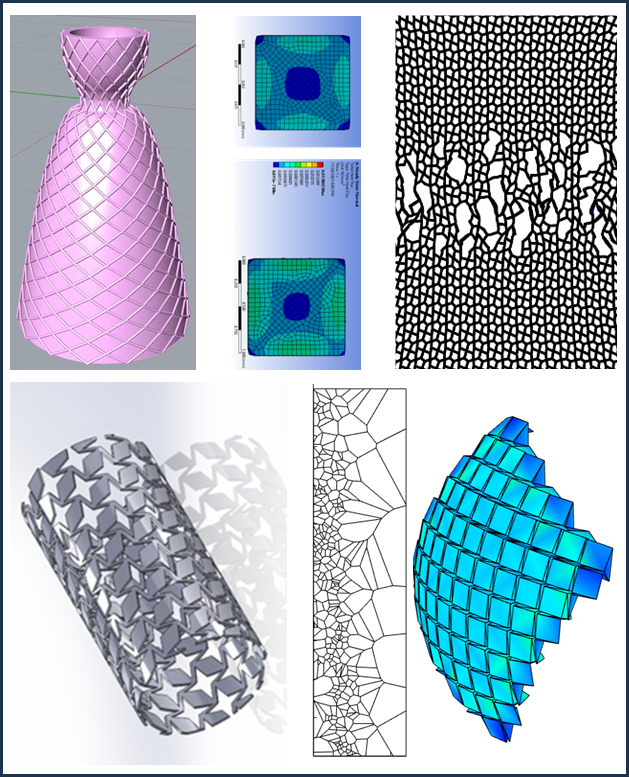
MEEN 703 is a hands-on graduate course developed by Dr. Krishnamurthy that teaches the theoretical and computational fundamentals of generative design. The course introduces geometric theory, algorithms, processing, and practical applications of generative design. Different themes of generative design are discussed including production systems, morphogenesis, evolutionary computing, self-organization, space-filling shapes, and machine-learning based generative methods.
A key pedagogical innovation is the integration of live coding modules where students develop and implement fundamental algorithms like L-systems, reaction-diffusion patterns, and Voronoi tessellations in real-time during class sessions. The course structure emphasizes both theoretical understanding through literature review of applications in structural, robotic, architectural, and biomedical systems, as well as practical implementation through coding exercises. The culminating research-based course project is designed to potentially lead to publishable work, providing students with real research experience in generative design methodologies. This approach creates an engaging learning environment that connects advanced algorithmic concepts with contemporary engineering design challenges.